Staring at fabric labels and wondering which ones are actually better? This sustainable fabrics guide gives the short answer: no fibre is perfect, so favour recycled or certified materials, and choose pieces you will wear for years.
This guide is part of our wider look at sustainable fashion, and it focuses on what your clothes are made of.
| Item | Value |
|---|---|
| Global fibre production, 2024 | 132 million tonnes |
| Polyester’s share of global output, 2024 | 59% |
| Recycled polyester production, 2024 | 9.3 million tonnes |
| Cotton’s share of global output, 2024 | 19% |
| Cotton produced to sustainability standards | 34% |
| Recycled cotton’s share of global cotton production | 1% |
These figures come from Textile Exchange’s market data as reported by Apparel Resources. Industry numbers get revised each year, so check the source before you rely on them.
What makes a fabric “sustainable”?
There is no single legal definition, so the word sustainable on a label can mean very different things. A useful fabric is one that does less harm at each stage: growing or making the fibre, dyeing and finishing, wearing and washing, and finally disposal.
It helps to ask four questions about any material:
- Where does the raw material come from, and was it grown or made with fewer chemicals and less water?
- Is it recycled, or could it be recycled at the end of its life?
- How long will it last, and does it keep its shape and colour?
- What happens when you wash it?
The last two matter more than people expect. A durable garment worn for years usually beats a “green” one that falls apart after a season.
The fibres you will meet most often
Most clothing falls into three families: synthetic, plant-based and animal-based, plus a growing group of recycled versions of each. Here is how the main ones compare in plain terms.
Synthetics: polyester and friends
Synthetics dominate the market. Textile Exchange reported that polyester alone represented 59% of global output in 2024, up from a 57% share in 2023, according to Apparel Resources.
Polyester is cheap and durable, but it is made from fossil fuels and sheds tiny plastic fibres when washed. Recycled polyester reduces the need for new raw material, though it is still a plastic fabric with the same washing issue.
Plant fibres: cotton, linen, hemp
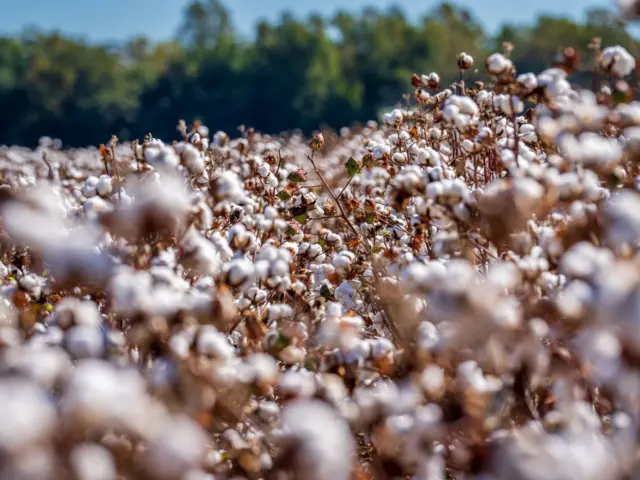
Cotton is the best-known natural fibre. Cotton accounted for 19% of fibre output in 2024 versus 20% in 2023; meanwhile, sustainability certification covered 34% of cotton production, compared with 28% a year earlier.
Linen (from flax) and hemp are often praised because the plants are generally hardy, and the fabrics are long-lasting and breathable. Look for the fibre content on the label rather than trusting a marketing claim alone.
Animal fibres: wool and others
Wool is warm, naturally odour-resistant and easy to repair. Its footprint depends heavily on farming practice and animal welfare, so look for credible third-party certifications and buy fewer, better pieces.
Regenerated fibres: viscose, lyocell, modal
These are made from wood pulp that is chemically processed into fibre. The raw material is renewable, but the impact depends on where the wood comes from and how well the chemicals are managed. Certified wood sourcing and closed-loop production are the signals worth looking for.
Why recycled and certified fabrics help, and where they fall short
Recycled materials keep existing resources in use. Textile Exchange’s data show recycled polyester output reached 9.3 million tonnes, compared with 8.9 million tonnes previously, while recycled cotton stayed at 1% of global cotton production, or 300,000 tonnes (Apparel Resources).
That gap shows recycling is still small next to the volume of new fibre made. Even so, a recycled or certified label is a better starting point than no information, as long as the claim names a recognised standard.
Be wary of vague wording such as “eco”, “green” or “conscious”. If a brand cannot say what the claim refers to, treat it as marketing.
The washing problem: microfibres
Synthetic clothes shed microfibres every time they go through the machine. Greenpeace says one piece of clothing can release 700,000 fibres in a single wash, though the real amount will vary with the fabric and the wash (Greenpeace International).
The same page reports that the IUCN estimates particles released directly by household and industrial products could account for 15%–31% of marine plastic pollution, with washing synthetic textiles contributing 35% of that category. These are modelled estimates, so treat them as a sign of scale, not exact measurements.
Simple habits reduce shedding:
- Wash less often and only with full loads.
- Use a cool, gentle cycle.
- Consider a washing-bag or filter designed to catch fibres.
- Choose natural or longer-lasting blends where they suit the garment.
Care: making any fabric last longer
How you look after clothes decides how long they stay out of the bin. Good care is the cheapest form of sustainability, because it needs no new purchase at all.
- Follow the care label, and wash only when a garment is actually dirty.
- Air clothes between wears, especially wool and linen.
- Dry on a line or rack when you can, since heat wears fibres down.
- Mend small problems early: a loose button or open seam is a quick fix.
When a piece finally reaches the end of its life, pass it on, repurpose it as a cloth, or use a textile collection point if one is near you. Mixed-fibre fabrics are harder to recycle, so single-fibre garments are easier to give a second life.
How to choose fabrics in practice
Start with what you already own, because the lowest-impact garment is usually the one in your wardrobe. When you do need something new, check the label for fibre content, look for a named certification, and judge the stitching and weight of the fabric.
Pairing good fabric choices with a smaller, well-planned collection works best, which is where how to build a capsule wardrobe can help you buy less and wear more. To see why volume matters so much, read about fast fashion environmental impact.
A quick checklist before you buy:
- Will I wear this again and again, across seasons?
- Is the fibre recycled, certified or clearly labelled?
- Can I wash it gently and repair it?
Frequently asked questions
Is natural always better than synthetic?
Show answer
No. Natural fibres can carry heavy farming impacts, while synthetics shed plastic fibres. How long you wear the garment and how you care for it often matter as much as the fibre.
Is recycled polyester a good choice?
Show answer
It is usually better than virgin polyester because it uses existing material, but it still sheds microfibres. Textile Exchange data put recycled polyester at 9.3 million tonnes in 2024, small beside total polyester output.
Does certified cotton mean organic?
Show answer
Not necessarily. The 34% certified figure covers cotton produced to sustainability standards generally, and organic is only one type of standard. Check which certification a product names.
How can I tell if a green claim is trustworthy?
Show answer
Look for a specific, named standard or a stated percentage of recycled content. Vague words with no detail are a warning sign.